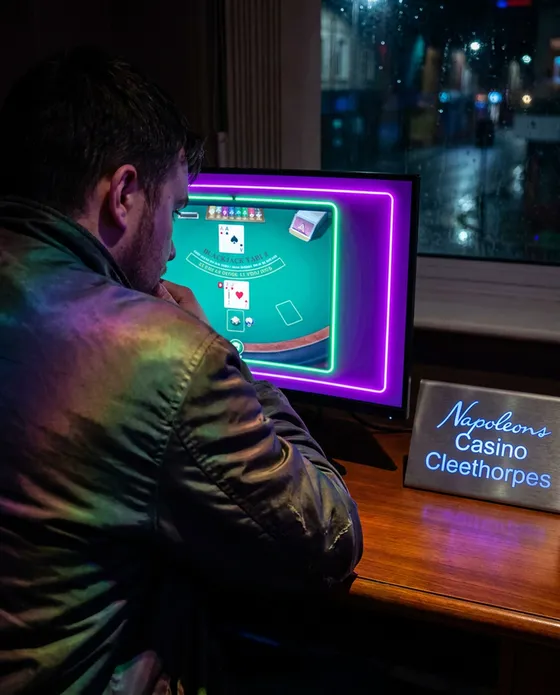

Blackjack at Napoleons Near Cleethorpes
If you are based in Cleethorpes and want a real, felt blackjack table instead of a screen, the nearest Napoleons venue for you is our casino in Hull. We also operate casinos in Leeds, Bradford, Sheffield Ecclesall, Sheffield Owlerton and London, but in practice Hull is the one that makes sense for most people travelling out from Cleethorpes. At every one of these sites blackjack is one of our core games, sitting alongside American Roulette and Three Card Poker on the main gaming floor.
On our website napoleons-casinos.co.uk we publish our own “How to Play Blackjack” material. It runs through the table rules, payout structure, basic hand signals and what is expected when you sit down. It is written for new players, not just as a formality for experienced regulars, so if you have never played in a casino before it is genuinely worth ten minutes of your time before you set off.
Entry to our venues follows standard UK casino rules. You must be at least 18 to come in, and anyone who looks under 21 should expect to be asked for valid photo ID at the door. We combine the casino floor with an on-site restaurant and bar, which means you can eat, have a drink and then play - or the other way round - without having to move between different venues in the same night.
How the Game Works at Our Tables
Blackjack at our tables keeps to a simple core: you try to finish with a total that is higher than the dealer’s hand, but you must not go over 21. If your hand goes over 21, it is a bust and your stake on that hand is lost immediately. The dealer will continue drawing cards until reaching at least 17, then must stand, no matter what total you are holding on your side of the table.
The strongest possible starting hand is a natural blackjack: one Ace together with any 10-value card in your opening two cards. When that happens at our tables, we pay natural blackjack at 3:2. So if you have staked £10 and hit a natural, your profit is £15, with £25 in total returned to you. The only exception is when the dealer also has a natural blackjack - in that situation the hand is treated as a push, no one wins and your original stake is simply returned.
All other winning outcomes where your hand beats the dealer but is not a natural blackjack pay at even money, 1:1. That difference between a natural blackjack and a 21 built from multiple cards is more important than it first sounds. A total of 21 from three or more cards does not qualify as a natural, and the shift from 3:2 to even money affects how experienced players think about certain opening hands and when they decide to draw or stand.
| Hand Type | Payout | Condition |
|---|---|---|
| Natural Blackjack (Ace + 10-value) | 3:2 | Dealer does not also have blackjack |
| Standard winning hand | 1:1 (even money) | Hand beats dealer without natural blackjack |
| Push | Stake returned | Player and dealer totals are equal |
| Bust | Stake lost | Player hand exceeds 21 |
Splitting, Doubling and Your Options at the Table
Our blackjack rules allow several decisions once the first two cards are dealt. When your starting hand is made up of two cards of the same value, you may choose to split. Splitting breaks that pair into two separate hands. A second wager equal to your original stake is placed on the new hand, and you then play each hand in turn. If you keep drawing matching cards, you can split again under our rules, which gives you extra flexibility in those particular spots.
Aces are handled in a slightly different way. When you split a pair of Aces at our tables, each Ace receives exactly one additional card only. There is no option to hit again on those hands. If any of those new hands ends up as Ace plus a 10-value card, that total is treated as 21 and not as a natural blackjack. That means the payout is even money rather than 3:2. This rule is consistent across all our venues and is clearly set out in our official blackjack information.
We also offer doubling down. After you see your first two cards, you can choose to double your initial bet, on the condition that you will receive just one more card and then must stand. In real play this option is most effective when your starting total is strong and the dealer’s upcard looks weak, for example certain 9, 10 or 11 totals against a low dealer card. It is not a tool for every hand, but it is a key part of how regular blackjack players approach the game.
At our blackjack tables you will make four core decisions during play:
- Hit - you ask the dealer for another card to increase your total.
- Stand - you keep your current total and end your turn.
- Double Down - you double your original bet, receive one final card and then stand.
- Split - you turn a matching pair into two separate hands with an extra stake.